
The Shotscribus Software Upgrade has become a frequently discussed topic among designers, publishers, and students who rely on open-source tools for professional layout and design work. In practical terms, it refers to the continuous updates and improvements made to the desktop publishing software Scribus.
Scribus is widely used as a free alternative to commercial design tools, offering powerful page layout capabilities for print and digital publishing. This review provides a clear, realistic, and experience-based breakdown to help you decide whether upgrading is worth it.
What Is the Shotscribus Software Upgrade?
It refers to updated versions of Scribus that introduce improvements in stability, performance, compatibility, and publishing accuracy. Since Scribus is maintained by an open-source development community, updates are released regularly to refine existing features rather than drastically change the software.
Unlike commercial tools that focus on major visual redesigns, Scribus upgrades typically focus on reliability, file handling, and professional output quality.
An Outline of Shotscribus Software
Scribus is a desktop publishing application designed for creating professional layouts. It is commonly used for producing printed and digital materials that require precise formatting.
It is used for tasks such as magazine design, brochure creation, poster layout, and multi-page document publishing. It also supports print-ready PDF generation, which makes it suitable for professional printing workflows.
One of its key strengths is that it remains free while still offering advanced layout control and professional publishing features.
What’s New in the Latest Upgrade
Although each version update may differ slightly, the Shotscribus Software Upgrade generally focuses on incremental but meaningful improvements.
These typically include better document stability during heavy editing, improved accuracy in PDF export, enhanced font rendering, and bug fixes related to layout and object positioning. Compatibility improvements for modern operating systems are also commonly included.
Rather than introducing unnecessary complexity, the upgrade aims to refine performance and make the software more reliable for real production environments.
The Significance of This Upgrade
In desktop publishing, precision and stability are essential. Even small improvements can significantly affect the final output.
A minor fix in text alignment or export accuracy can influence print quality, professional presentation, and compatibility with printing systems. Workflow efficiency also improves when fewer errors and crashes interrupt the design process.
For this reason, staying updated with it is important for users who depend on consistent output quality.
Is the Shotscribus Software Upgrade Worth It?
The value of the upgrade depends on how actively the software is used.
The main advantages include improved stability, better compatibility with modern systems, more reliable PDF export, and reduced risk of crashes or file errors. These improvements directly benefit users working on serious publishing projects.
However, there are limitations. The interface does not receive major visual redesigns, and beginners may still find the software complex. Compared to premium tools, the overall polish is more functional than modern.
New Features Included in the Shotscribus Software Upgrade
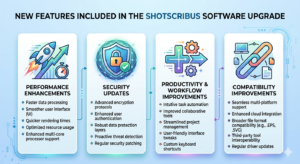
The interface changes are subtle but useful. Improvements generally focus on better organization of tools, more consistent workspace behavior, and smoother panel interactions. The goal is to improve usability without changing the core structure of the software.
Performance Enhancements
Performance is one of the key areas of improvement. The upgraded version handles complex layouts more efficiently, reduces lag during editing, and improves responsiveness when working with large files or high-resolution images.
These enhancements are especially noticeable in multi-page documents and detailed design projects.
Security Updates
Although Shotscribus software upgrade is not a cloud-based platform, security still matters in terms of file stability and system reliability. Updates often include bug fixes that prevent crashes, improvements in file handling, and updates to underlying system components.
These changes help reduce the risk of corrupted or unreadable project files.
Productivity and Workflow Improvements
Workflow improvements focus on making design tasks more efficient. Text flow control becomes more accurate, alignment tools behave more consistently, and object grouping and layering systems become more reliable.
These refinements reduce manual corrections and help speed up the overall design process.
Compatibility Improvements
Compatibility is an important part of each upgrade. New versions typically improve support for modern operating systems, updated font formats, and commonly used image and print file types.
This ensures that the software remains usable in evolving production environments.
Shotscribus Software Upgrade Performance Review
The upgraded version performs better when handling large or complex design projects. Multi-page documents, high-resolution images, and detailed vector elements load more smoothly compared to older versions.
While it may not match the speed of premium commercial tools, it performs reliably for most professional and educational use cases.
Stability and Reliability
Stability is one of the strongest improvements in recent updates. Users experience fewer unexpected crashes, reduced risk of file corruption, and more predictable editing behavior. This makes the software more dependable for long-term projects.
Resource Usage and Efficiency
Scribus remains relatively lightweight compared to many modern design tools. It runs effectively on mid-range systems and does not require high-end graphics hardware. It is also known to perform well on Linux systems, making it accessible across different environments.
Benefits of Upgrading to the Latest Version
Upgrading provides several practical benefits. The overall user experience becomes smoother, with fewer interruptions during design work. Security and file reliability improve due to bug fixes and system updates.
Productivity increases because users spend less time troubleshooting errors and more time working on actual design tasks. In addition, staying updated ensures better compatibility with future operating system changes.
How to Shotscribus Software Upgrade
Before upgrading, users should save all active projects and create backups of important files. It is also recommended to close the software completely and ensure the system meets minimum requirements.
The upgrade process generally involves downloading the latest version, running the installer, and completing installation over the existing version or performing a fresh install if needed. After installation, restarting the system may help ensure proper configuration.
Once updated, users should check fonts, workspace settings, and older project files to ensure everything functions correctly.
System Requirements and Compatibility
Scribus supports major operating systems including Windows, Linux, and macOS. It is designed to run on relatively modest hardware.
A minimum of four gigabytes of RAM is required, although eight gigabytes is recommended for larger projects. A dual-core processor or better is sufficient for most tasks, along with adequate storage for design files.
Most existing project files remain compatible across versions, although complex legacy files may occasionally require minor adjustments.
Common Problems and Troubleshooting
Some users may experience installation issues, which are often resolved by running the installer with administrative permissions or temporarily disabling antivirus software.
Compatibility errors are usually fixed by updating system libraries or reinstalling missing fonts. Performance issues can often be resolved by clearing cache files, updating drivers, or simplifying large documents.
In cases of major version upgrades, a fresh installation or reset of workspace settings may help improve stability.
Shotscribus Software Upgrade vs Previous Versions
Compared to older versions, the upgraded Scribus offers better layout precision, improved PDF export quality, and more stable typography handling. Performance improvements are noticeable in large and complex projects, with faster loading and smoother editing.
Security and file handling reliability are also improved, reducing the likelihood of errors during production work.
Overall, improvements are gradual but meaningful, focusing on stability and refinement rather than redesign.
Pros and Cons of the Shotscribus Software Upgrade
| Pros | Cons |
| Free and open-source software with no licensing cost | Interface feels outdated compared to modern design tools |
| Improved stability and fewer crashes in newer versions | Steep learning curve for beginners |
| Better performance in handling large and complex documents | Limited advanced automation features compared to premium tools |
| Enhanced PDF export quality for print-ready output | Occasional manual adjustments required for complex layouts |
| Improved compatibility with modern operating systems | Not as visually polished as commercial alternatives |
| Lightweight and works well on mid-range systems | Fewer built-in templates and design resources |
| Strong community support and continuous updates | UI can feel technical and less intuitive |
Who Should Upgrade
The upgrade is suitable for students learning design, freelancers working on publishing projects, and professionals handling print or layout-based work. It is also useful for teams involved in marketing, publishing, or content production.
Who Should Wait
Users with older systems or limited hardware may prefer to delay upgrading until compatibility is confirmed. Organizations that require extensive testing before deployment may also choose to wait.
Is the Shotscribus Software Upgrade Worth It?
It is worth it because Scribus is completely free, so the value comes from performance and stability improvements rather than cost. The upgrade mainly enhances system reliability, smoother workflow, and better compatibility with modern operating systems. Users who actively work on design or publishing projects will notice fewer crashes and improved editing performance.
It also improves file handling and export quality, especially for print-ready documents. For regular users, these improvements make daily tasks more efficient and less frustrating. Overall, upgrading is a practical decision that improves long-term usability without any extra expense.
Expert Assessment
It is a practical and stability-focused improvement rather than a cosmetic one. It enhances reliability, improves performance, and ensures better compatibility with modern systems.
While it does not transform the interface or introduce major visual changes, it strengthens the core experience significantly.
For anyone regularly using Scribus for design or publishing, upgrading is a sensible and recommended decision.
Final Verdict
The Shotscribus Software Upgrade delivers meaningful improvements in stability, performance, and usability while maintaining the simplicity and open-source nature of the software.
It is best suited for users who rely on Scribus for real design and publishing work, where reliability and output quality matter more than visual redesigns. Upgrading is not just optional maintenance; for active users, it is a practical step toward a more stable and efficient workflow.